Landscape Analysis Toolkit

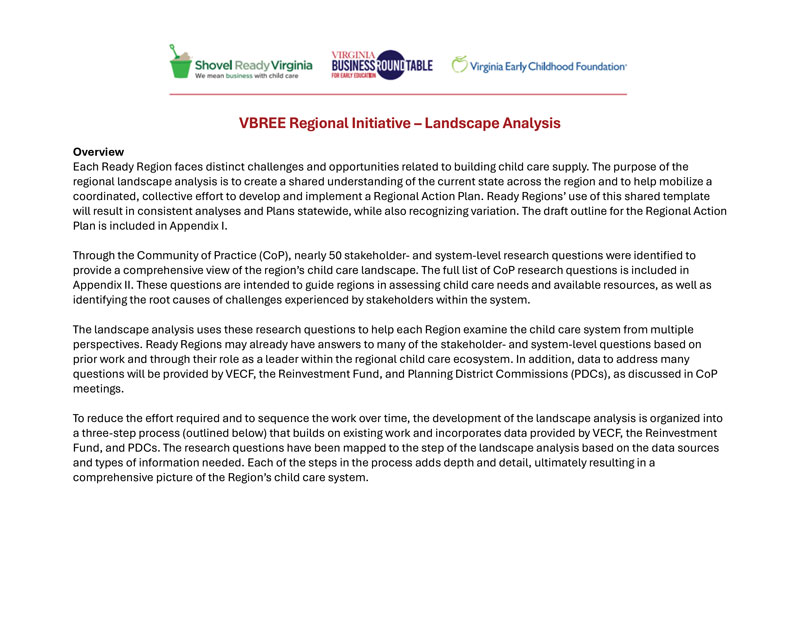
Landscape Analysis Toolkit

Each Ready Region faces distinct challenges and opportunities related to building child care supply. The purpose of the regional landscape analysis is to create a shared understanding of the current state across the region and to help mobilize a coordinated, collective effort to develop and implement a Regional Action Plan. Ready Regions’ use of this shared template will result in consistent analyses and Plans statewide, while also recognizing variation.
Read More »
Section 4. Creating New Pathways and Resources

Section 4. Creating New Pathways and Resources

High-quality, affordable child care presents win-win opportunities for many diverse stakeholder groups and sectors. Forging these new partnerships and building new resources to fill gaps can open new potential solutions for child care in the region. This section of the Playbook focuses on topics related to creating new pathways and resources to use for building child care supply.

Read More »
Section 3. Leveraging Existing Resources

Section 3. Leveraging Existing Resources

Existing human, financial, social, and physical capital present opportunities to leverage for increasing access to child care. This section of the Playbook focuses on topics related to harnessing existing regional resources, including facility space, financing, and partnerships, to amplify and accelerate initiatives to build child care supply.

Read More »
Section 1. Understanding the Landscape

Section 1. Understanding the Landscape

Regional syntheses across Virginia allow for a common understanding of the current state and help mobilize aligned, collective commitment to plan to grow the supply of child care that can address specific challenges and yield returns in each region. This section of the Playbook focuses on topics related to the development of a current state landscape analysis and a Regional Action Plan that reflects the child care challenges and opportunities of the region.

Read More »
Group of kindergarten kids clapping with a teacher.

ECCE Business Academy Budgeting Tool

In response to many requests for business supports from Early Childhood Care and Education (ECCE) site leaders and Ready Regions, VECF convened the Early Educator Finance and Compensation Task Force, a group of veteran ECCE site leaders, to help develop this training in collaboration with financial planning and resiliency experts, 20 Degrees. This means that the tool was designed and tested by ECCE providers for ECCE providers.

Read More »
Section 2. Building a Policy Foundation

Section 2. Building a Policy Foundation

Access to high-quality, affordable child care is affected by laws, policies, and governmental actions, including at local and regional levels. Some policies are obvious in their impact on child care supply, while others may have a less direct yet still meaningful effect on the system. This section of the Playbook focuses on topics related to systems-level changes that contribute to a regional policy environment that creates favorable conditions to build child care supply.

Read More »

Child Care as Regional Infrastructure

Treating child care as regional infrastructure means integrating child care development into long-range planning processes alongside transportation, housing, and economic development. It is a proactive, systems approach that coordinates regulatory alignment, facility development, and funding strategies to build lasting supply.

Read More »